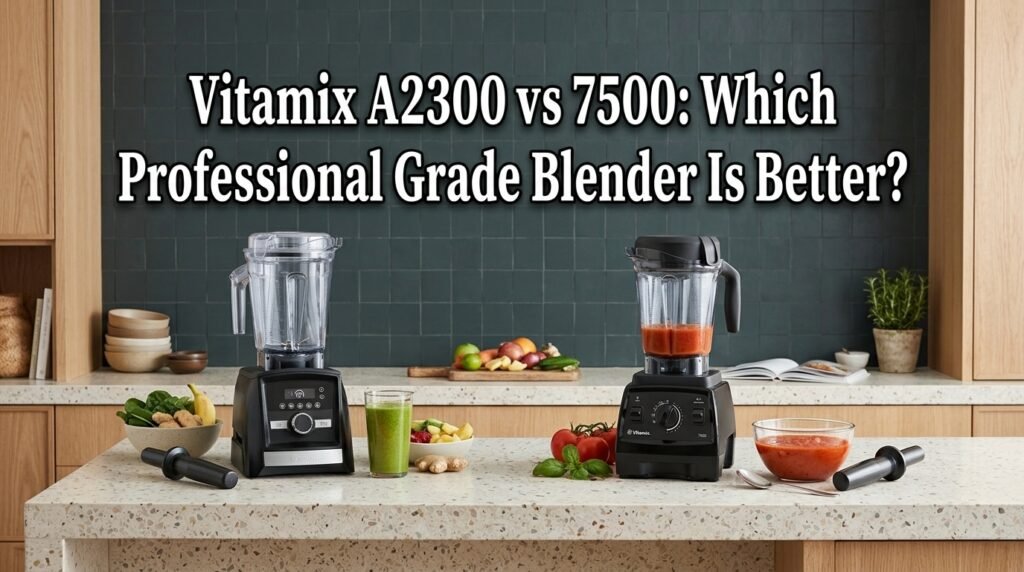
A powerful blender can make everyday kitchen preparation much easier, but choosing the right model involves more than comparing motor strength. Container design, speed adjustments, blending controls, and cleaning convenience all influence how useful a blender will be over time. The Vitamix A2300 and Vitamix 7500 are both professional-grade models featuring 64-ounce low-profile containers, variable speed control, and Pulse functionality. However, they take different approaches to blending, particularly when it comes to technology and user controls.
The A2300 belongs to Vitamix’s Ascent Series and includes built-in wireless connectivity, compatible Self-Detect containers, and a digital timer. The 7500 takes a more traditional approach, emphasizing ten variable speeds, hardened aircraft-grade stainless-steel blades, and a convenient self-cleaning process. Rather than assuming the newer technology automatically makes one model better, I’ll compare their practical features to help you decide which blender better suits your kitchen.
Key Difference Between Vitamix A2300 vs 7500 Professional Blender
The Vitamix A2300 stands out for its smart features, including wireless connectivity, Self-Detect container compatibility, and a digital timer. The Vitamix 7500 focuses on traditional manual blending with ten variable speeds, hardened aircraft-grade stainless-steel blades, and a specified 30–60-second self-cleaning process.
Vitamix A2300 vs 7500: Comparison Table
| Feature | Vitamix A2300 | Vitamix 7500 |
|---|---|---|
| Series | Ascent Series | Traditional Vitamix |
| Container Capacity | 64 oz | 64 oz |
| Container Design | Low-profile | Low-profile |
| Speed Control | 10 variable speeds | 10 variable speeds |
| Pulse Function | Yes | Yes |
| Digital Timer | Yes | Not specified |
| Wireless Connectivity | Yes | Not specified |
| Self-Detect Compatibility | Yes | Not specified |
| Stainless-Steel Blades | Yes | Hardened aircraft-grade |
| Self-Cleaning | 30–60 seconds | 30–60 seconds |
| Thermal Protection | Yes | Yes |
| Electrical Rating | 120V - 1500W | 120V, 50/60Hz, 12A |
| Cord Length | 6 feet | 6 feet |
| Check Latest Price & Deals | Buy on Amazon | Buy on Amazon |
Detailed Comparative Review
Although both blenders share the same 64-ounce low-profile container format, their feature sets reveal two different priorities. The A2300 is designed around connected technology and additional feedback during blending, while the 7500 concentrates on manual speed control and practical performance features. I would compare them based on how much assistance I want from the machine rather than assuming that newer technology automatically makes one model better.

- You're in Control: Variable Speed Control and Pulse feature let you manually fine-tune the texture of any recipe


- Variable Speed Control: Ten variable speeds allow you to refine every texture with culinary precision, from the...
Design
The Vitamix A2300 has a modern appearance that fits naturally into the Ascent Series lineup. Its low-profile 64-ounce container is one of its most practical design features. It provides enough capacity for family meals and larger batches while remaining short enough to fit comfortably under many kitchen cabinets. I like this arrangement because a large-capacity blender is more convenient when it does not require extra clearance every time I need to use it.
The motor base is where the A2300 becomes more interesting. Its built-in wireless connectivity allows it to communicate with compatible Self-Detect containers. The machine can automatically adjust maximum blending times according to the container being used. This creates an expandable setup for people who may eventually want to add different compatible container sizes.
The digital timer also gives the control area a more modern feel. It provides a visual reference when following recipes that require manual blending, making it easier to monitor processing time.
The Vitamix 7500 has a more straightforward design. It also features a 64-ounce low-profile container, so its capacity and cabinet-friendly proportions are comparable to the A2300. Its appearance is more traditional, with the focus placed on accessible manual controls rather than wireless connectivity.
One practical detail worth noting about the 7500 is its six-foot power cord, which provides some flexibility when positioning the blender on the countertop. It also includes a radial cooling fan and thermal protection system, features designed to help manage heat during operation.
My take: Both models have a practical low-profile container design, so neither has a major advantage in capacity or cabinet clearance. I prefer the A2300’s modern technology and expandable container system, while the 7500 appeals to me if I want a simpler blender without connected features.
- You're in Control: Variable Speed Control and Pulse feature let you manually fine-tune the texture of any recipe
Ease of Use
The A2300 offers a useful combination of manual control and additional assistance. Its variable speed control lets me adjust blending intensity depending on the recipe, while the Pulse function makes it possible to combine smooth and coarse textures in the same preparation. For example, I could use Pulse to add chunky ingredients to a smoother soup or create a heartier pasta sauce.
I particularly like the digital timer because it removes some of the guesswork when following recipes. Instead of relying entirely on estimation, I can monitor the processing time while adjusting the speed manually. This is especially useful when trying to repeat a particular texture.
The wireless connectivity is another convenience. When a compatible Self-Detect container is attached, the motor base recognizes the container and adjusts the maximum blending time accordingly. This makes the A2300 more adaptable if I want to build a larger blending system over time.
The Vitamix 7500 keeps things more traditional. Its ten variable speeds give me direct control over texture, from smooth purées to coarser preparations. The Pulse function provides another way to control consistency without relying on automatic programs.
I also find the 7500’s control approach appealing because it does not introduce additional connected features that some users may never need. A built-in digital timer is not listed among its features, so buyers who want that particular convenience may prefer the A2300.
My take: The A2300 is more convenient if I appreciate a digital timer and smart container recognition. The 7500 is easier to approach as a traditional manual blender, particularly for someone who simply wants variable speed and Pulse controls.
- Variable Speed Control: Ten variable speeds allow you to refine every texture with culinary precision, from the...
Functions
Both blenders are designed for a wide range of kitchen tasks, and their shared 64-ounce capacity makes them suitable for preparing larger portions. Their variable speed and Pulse controls are especially useful because they allow different textures rather than limiting the user to a single blending intensity.
The A2300’s main advantage is its connected blending system. Its built-in wireless connectivity allows the motor base to recognize compatible Self-Detect containers and adjust maximum blending times based on the selected container. This is particularly interesting if you want to use smaller containers for individual portions alongside the standard 64-ounce container.
Its digital timer is another practical feature. When processing ingredients manually, I can monitor the blending duration and make adjustments as needed. The Pulse function also provides flexibility for recipes where I want a mixture of smooth and chunky ingredients rather than a completely uniform result.
The Vitamix 7500 takes a more direct approach to blending. Its ten variable speeds provide detailed manual adjustment, while Pulse helps create chunky textures for salsa, vegetable soups, and similar recipes. One of its most notable specifications is the hardened aircraft-grade stainless-steel blade assembly, which Vitamix describes as being designed to handle tough ingredients.
The 7500 also includes a radial cooling fan and thermal protection system. These are useful design features for managing heat during operation. Its electrical rating is 120 volts, 50/60 Hz, and 12 amps.
I would not automatically assume that the 7500 has weaker or stronger blending performance than the A2300 based on these specifications alone. Without directly comparable motor and blade details for both models, there is not enough information to establish a performance winner.
My take: I give the A2300 the advantage for smart functionality and compatibility with additional containers. The 7500 is more appealing if I value its specified blade construction, ten-speed manual control, and thermal protection system. Both provide the core speed and Pulse functions needed for versatile blending.
Maintenance
Cleaning is one of the details I would consider carefully before choosing a countertop blender. Even a powerful machine becomes less convenient if cleaning takes too much effort after every recipe.
The Vitamix 7500 has a clear advantage in this area because its self-cleaning function is specifically listed. The process is straightforward: add warm water and a drop of dish soap, then run the blender for approximately 30 to 60 seconds. This helps remove food residue from the container without requiring extensive manual scrubbing.
I consider this particularly useful after preparing smoothies, purées, soups, and other mixtures that can leave residue around the container. It does not eliminate the need for occasional deeper cleaning, but it makes routine cleanup easier.
The A2300’s listed features do not specifically identify a self-cleaning program. I would therefore avoid assuming that it has the same documented cleaning function as the 7500. Its container and motor base still require normal care according to the manufacturer’s cleaning instructions.
The 7500 also includes a radial cooling fan and thermal protection system. These are not cleaning features, but they are worth considering as part of the machine’s overall design. The A2300’s wireless connectivity and compatible container system provide flexibility, although they do not establish a maintenance advantage.
My take: The Vitamix 7500 is my choice for routine cleaning convenience because its 30–60-second self-cleaning process is clearly specified. I would check the A2300’s official cleaning instructions before deciding whether it offers an equivalent feature.
Vitamix A2300 Ascent Series Smart Blender
- You're in Control: Variable Speed Control and Pulse feature let you manually fine-tune the texture of any recipe
Pros:
- Professional-grade Ascent Series blender.
- Large 64-ounce low-profile container.
- Variable speed control and Pulse function.
- Built-in wireless connectivity.
- Compatible with Self-Detect containers.
- Automatically adjusts maximum blending time based on container size.
- Digital timer for manual blending.
- Expandable blending system with compatible containers.
Cons:
- A self-cleaning function is not listed among its specified features.
- Blade construction is not specified here.
- Electrical rating and cord length are not provided here.
- Some users may not need wireless connectivity or additional container compatibility.
Vitamix 7500 Professional Grade Blender
- Variable Speed Control: Ten variable speeds allow you to refine every texture with culinary precision, from the...
Pros:
- Professional-grade blender with a 64-ounce low-profile container.
- Ten variable speed settings.
- Pulse function for controlling texture.
- Hardened aircraft-grade stainless-steel blades.
- Self-cleaning in approximately 30–60 seconds.
- Radial cooling fan and thermal protection system.
- Six-foot power cord.
- Straightforward manual controls.
Cons:
- Built-in wireless connectivity is not listed.
- Self-Detect container compatibility is not listed.
- A digital timer is not listed.
- Less emphasis on smart blending features than the A2300.
Final Verdict: Which Vitamix Blender Should You Buy?
After comparing the Vitamix A2300 and 7500, I would choose the Vitamix A2300 if smart features and future flexibility are my priorities. Its built-in wireless connectivity, Self-Detect container compatibility, and digital timer make it a more technologically advanced option. I particularly like the possibility of adding compatible containers over time and having the motor base recognize the selected container automatically.
However, the Vitamix 7500 is still a very appealing blender for someone who prefers traditional manual control. Its ten variable speeds, Pulse function, hardened aircraft-grade stainless-steel blades, and documented self-cleaning process cover several practical everyday needs. I also appreciate its radial cooling fan and thermal protection system.
My recommendation depends on how you plan to use your blender. Choose the A2300 if you want a connected blending system with a digital timer and expandable container compatibility. Choose the 7500 if you prefer a straightforward machine with ten manual speeds, specified blade construction, and convenient self-cleaning.
For my overall pick, I would lean toward the Vitamix A2300 because its smart features give it more flexibility beyond the standard blending functions. But if you do not need wireless connectivity or a digital timer, the Vitamix 7500 may be the more practical choice.
Frequently Asked Questions
Is the Vitamix A2300 better than the 7500?
The A2300 offers more technology-focused features, including wireless connectivity, a digital timer, and compatibility with Self-Detect containers. The 7500 offers ten variable speeds, hardened stainless-steel blades, and a specified self-cleaning function. The better model depends on whether you value smart features or traditional blending convenience.
Do the Vitamix A2300 and 7500 have the same container capacity?
Yes. Both models include a 64-ounce low-profile container. This capacity is suitable for family-sized recipes and larger batches, while the low-profile design helps the containers fit under many kitchen cabinets.
Does the Vitamix A2300 have a self-cleaning function?
A self-cleaning function is not specifically listed among the A2300’s features discussed here. The Vitamix 7500 explicitly includes a cleaning process using warm water and a drop of dish soap that takes approximately 30 to 60 seconds.
Can the Vitamix A2300 use different container sizes?
Yes. The A2300 supports compatible Self-Detect containers. Its built-in wireless connectivity allows the motor base to recognize the selected container and automatically adjust the maximum blending time according to its size.
Which Vitamix blender is better for making smoothies and soups?
Both models offer variable speed control, Pulse functionality, and a 64-ounce container, making them suitable for preparing smoothies and soups. The A2300 adds a digital timer and smart container compatibility, while the 7500 offers ten variable speeds and specified aircraft-grade stainless-steel blades. Either can be a suitable choice depending on the controls and additional features you prefer.