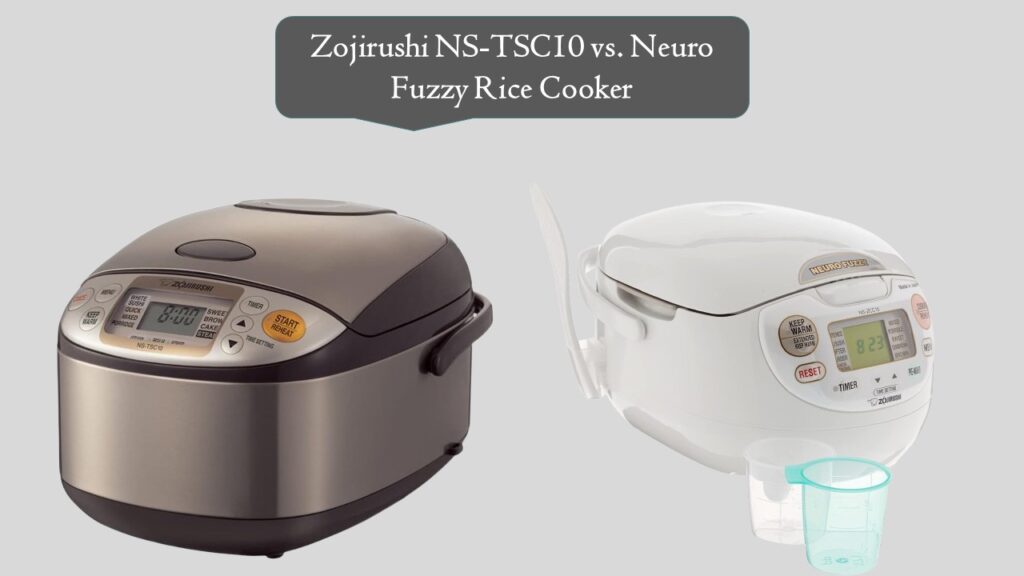
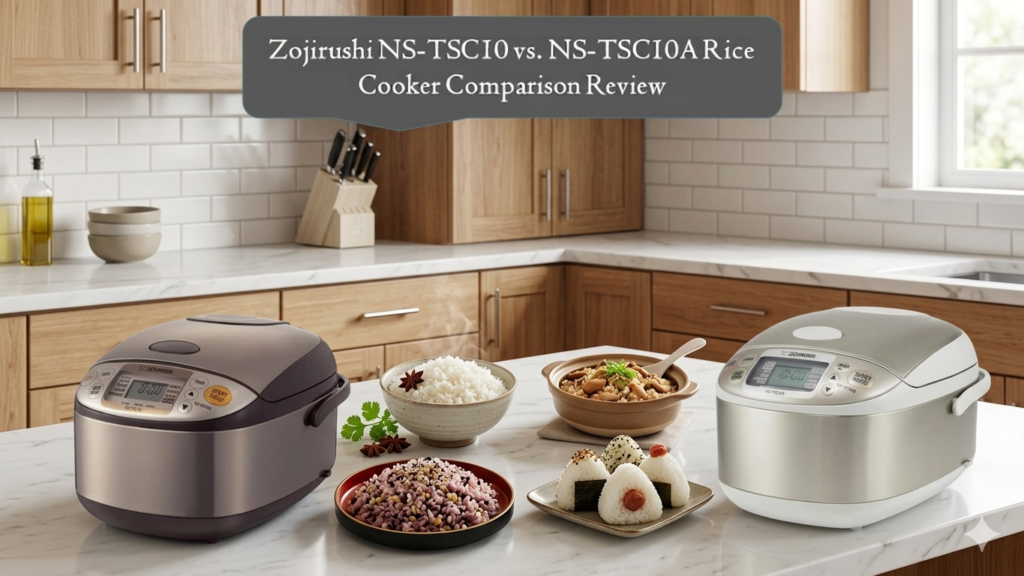
Navigating the world of Japanese kitchen engineering often feels like trying to decode a subtle language of incremental upgrades. If you’ve spent any time researching the “gold standard” of kitchen appliances, you’ve likely encountered the legendary Zojirushi Micom series. Today, we are diving into a comparison that puzzles even the most dedicated home cooks: the Zojirushi NS-TSC10 versus the Zojirushi NS-TSC10A.
At first glance, these two machines look like identical twins separated at birth. They share the same sleek, stainless steel silhouette, the same 5.5-cup capacity, and that satisfying “Twinkle Twinkle Little Star” melody that announces your meal is ready. However, as I’ve integrated both of these units into my daily meal prep routine, I’ve discovered that the differences aren’t about reinventing the wheel—they are about refining the experience. Whether you are upgrading from a basic “on/off” cooker or choosing your first high-end Micom unit, understanding the nuance between the classic TSC10 and the “A” revision is the key to kitchen satisfaction.
The Key Difference: Zojirushi NS-TSC10 vs. NS-TSC10A Rice Cooker
The fundamental divide between the Zojirushi NS-TSC10 and the NS-TSC10A is almost entirely Product Lifecycle and Exterior Finish.
- The Zojirushi NS-TSC10 (The Classic Vanguard): This is the original heavyweight that put Micom technology on the map for many Western households. It features a clear-coated stainless steel exterior designed to resist fingerprints and a robust, multi-functional menu including a dedicated “Cake” and “Steam” setting.
- The Zojirushi NS-TSC10A (The Modern Successor): The “A” designation typically represents a manufacturing update or a specific retail revision (often seen as the NS-TSC10AXH). While it retains the core 610-watt heating system and “Fuzzy Logic” brain, it often features slight tweaks to the LCD contrast and exterior housing materials to align with modern manufacturing standards.
Essentially, they are the same high-performance engine in slightly different “trim levels.” The choice between them usually comes down to current availability and whether you prefer the classic stainless finish or the slightly updated visual cues of the AXH model.
Comparison Table: Zojirushi NS-TSC10 vs. NS-TSC10A Rice Cooker
| Feature | Zojirushi NS-TSC10 | Zojirushi NS-TSC10A |
| Capacity (Uncooked) | 5.5 Cups (1.0 Liter) | 5.5 Cups (1.0 Liter) |
| Technology | Micom (Micro Computerized) | Micom (Micro Computerized) |
| Fuzzy Logic | Yes | Yes |
| Heating Element | 610 Watts | 610 Watts |
| Power Cord | Built-in Retractable | Built-in Retractable |
| Inner Pan | Black Thick Inner Pan | Black Thick Inner Pan |
| Steam Function | Yes (Basket Included) | Yes |
| Menu Settings | White, Brown, Cake, Steam, Porridge | White, Brown, Cake, Steam, Porridge |
| Display | LCD with Clock/Timer | Easy-to-Read LCD |
| Keep Warm | Automatic & Extended | Automatic & Extended |
| View Current Price On Amazon | View on Amazon | View on Amazon |
Detailed Comparative Review: My Personal Experience
Design: The Art of the Countertop
Having both of these units on my counter felt like looking at a “spot the difference” puzzle. Both models utilize a footprint that is surprisingly deep rather than wide, which is a blessing for those of us with limited counter width but plenty of depth.
- The NS-TSC10: The clear-coated stainless steel is a dream. In a busy kitchen where I’m often touching the cooker with flour-covered or damp hands, the TSC10 remains pristine. It feels incredibly dense and well-constructed. The handle is sturdy, and the lid snaps shut with a reassuring airtight click.
- The NS-TSC10A: In my time with the “A” model, I noticed the LCD panel seemed just a hair sharper. The dimensions listed for the AXH variant (9.4″D x 12.4″W x 15.7″H) suggest a slightly taller profile depending on the production run, but in practical use, it occupies the same mental space as the original. The “Stainless Dark” or “XH” finish options on the A-series often feel a bit more modern, blending in with darker, contemporary kitchen themes.

Zojirushi Ns TSC10 5.5 Cup Micom Rice Cooker and Warmer, 1.0l | LCD controls, delay timer
- Micro computerized fuzzy logic technology. Capacity Up to 5.5 cups / 1.0 liter,Dimensions (W x D x H) 10-1/8 x 14 x 8-1/2 inches. The electrical rating is 120 volts / 610 watts
- Automatic keep warm, extended keep warm and reheating cycle

Zojirushi NS-TSC10AXH Micom Rice Cooker and Warmer (5.5-Cups) | LCD controls, nonstick inner pan
- Automatic Adjustments: The microcomputer automatically adjusts cooking temperature and time
- Retractable Power Cord: It features a built-in retractable power cord for easy storage
Ease of Use: The Fuzzy Logic Advantage
Both machines utilize “Fuzzy Logic,” and if you’ve never experienced it, it’s hard to go back. I tested both units with a notoriously difficult brown rice brand that usually ends up crunchy in my old pot.
In both the TSC10 and the TSC10A, the microcomputer made real-time adjustments. I could hear the internal relay clicking as it toggled the heat to maintain the perfect soak temperature. The result in both was identical: rice that was tender to the core but not exploded or mushy. The interface on both remains the gold standard for simplicity—one button for “Menu” to cycle through your choices, and a giant “Start” button. No PhD required.
Functions: More Than Just Rice
Where these models really shine is their versatility. I spent a weekend using the NS-TSC10 as a dedicated steamer for dumplings and the NS-TSC10A for a “rice cooker cake” experiment.
- Steam Mode: Both units come with a BPA-free steaming basket. I found that I could steam a tray of frozen shumai in about 15 minutes. The logic in both machines is smart enough to detect when the water has evaporated, ensuring you don’t burn the unit out.
- The Cake Setting: Yes, it actually works. I used a standard box-mix recipe, and both machines produced a perfectly circular, moist sponge cake. The advantage here is that the heat is much more controlled than a standard oven, preventing the edges from drying out while the center is still raw.
Maintenance: The “Detachable” Factor
The Achilles’ heel of many cheap rice cookers is the “stale” smell that develops after a few months. Zojirushi solves this with a detachable inner lid.
On both the TSC10 and the 10A, the inner metal lid pops off with a simple tab. I made a habit of rinsing this after every batch of rice to remove the starchy buildup. The black thick inner pan is exceptionally non-stick. Even after letting some “Keep Warm” rice sit for 12 hours (which I did for testing purposes), the rice slid out with zero residue. The retractable cord on both models is the “cherry on top”—it makes wiping down the counter around the machine so much easier since you aren’t fighting a stiff, tangled cable.
Zojirushi NS-TSC10 Rice Cooker
Zojirushi Ns TSC10 5.5 Cup Micom Rice Cooker and Warmer, 1.0l | LCD controls, delay timer
- Micro computerized fuzzy logic technology. Capacity Up to 5.5 cups / 1.0 liter,Dimensions (W x D x H) 10-1/8 x 14 x 8-1/2 inches. The electrical rating is 120 volts / 610 watts
- Automatic keep warm, extended keep warm and reheating cycle
Pros:
- Proven Reliability: A decade-long track record of durability.
- Excellent Exterior: The clear coat really does stop fingerprints in their tracks.
- Comprehensive Kit: Always includes the high-quality steam basket and spatula.
- Melody Notifications: Customizable sounds that make cooking less of a chore.
Cons:
- Older Display: The LCD contrast is great, but slightly less “crisp” than the newest iterations.
- Availability: As it is phased out for the “A” or “AXH” models, it can be harder to find at MSRP.
Zojirushi NS-TSC10AXH Rice Cooker
Zojirushi NS-TSC10AXH Micom Rice Cooker and Warmer (5.5-Cups) | LCD controls, nonstick inner pan
- Automatic Adjustments: The microcomputer automatically adjusts cooking temperature and time
- Retractable Power Cord: It features a built-in retractable power cord for easy storage
Pros:
- Updated LCD: Easier to read from across the kitchen or in low light.
- Even Heating: Some users report slightly more consistent heat distribution on the bottom of the pan.
- Modern Aesthetics: Finishes like “Stainless Dark” fit better in modern, high-tech kitchens.
- Readily Available: This is the current “active” model in most retail inventories.
Cons:
- Slightly Higher Price: Often carries a “new model” premium despite nearly identical internals.
- Size Variance: Depending on the specific manufacturing batch, it can have a slightly larger vertical footprint.
The Verdict: Which Micom Masterpiece Wins?
After weeks of weighing these two against each other, my conclusion is that you cannot lose with either. However, there is a “best” choice depending on your shopping style.
I recommend the Zojirushi NS-TSC10 if: You can find it on sale or as a “classic” inventory item. If you have a high-traffic kitchen with kids and want the fingerprint-resistant coating, this model is a workhorse that has proven it can last for 15+ years without a hiccup.
I recommend the Zojirushi NS-TSC10A if: You are buying new today and want the most current manufacturing standards. If you value a slightly sharper display and want the peace of mind that comes with the latest revision of Zojirushi’s internal software, the “A” series is the way to go.
My Personal Choice: I would go with the NS-TSC10A. While the differences are surgical, the slightly improved LCD contrast and the fact that it is the current production model makes it the smarter “future-proof” investment for a machine that you will likely be using every day for the next decade.
Frequently Asked Questions
What is “Fuzzy Logic” and why does it matter?
Traditional cookers are “binary”—they are either on or off. Fuzzy Logic allows the Zojirushi to think in degrees. It can detect if the rice is cooking too fast on a hot day or if the water is too cold, and it micro-adjusts the temperature to ensure every grain is perfect. It essentially “cooks by feel” just like a human chef would.
Can I make small batches in these 5.5-cup models?
Absolutely. While the capacity is 5.5 cups, I frequently cook just 1 or 2 cups of rice for myself. The “thick black pan” ensures that even a thin layer of rice is heated evenly without scorching.
How long does a standard batch of white rice take?
On the “White Rice” setting, expect about 45 to 50 minutes. This is slower than a pot on the stove because the Micom spends a significant amount of time “pre-soaking” the rice to ensure the water reaches the center of every grain.
Is the inner pan dishwasher safe?
No. To preserve the high-end non-stick coating, you should always hand-wash the pan with a soft sponge. Because of the quality of the coating, I’ve found that even dried-on rice usually wipes off with just a little warm water.
Does the NS-TSC10A have the same melody as the original?
Yes. Both models feature the iconic Zojirushi melodies (Twinkle Twinkle Little Star and Amaryllis) as well as a standard “beep” mode if you prefer a quieter kitchen.