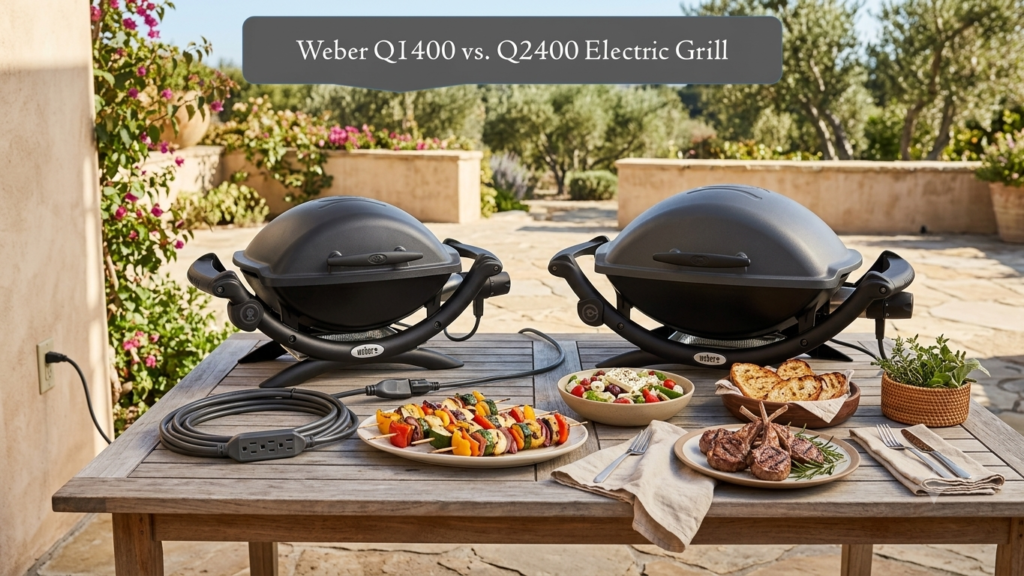
City living often comes with a frustrating caveat for those who crave the sizzle of a Sunday afternoon: the dreaded “no charcoal, no gas” rule. I found myself in this exact predicament last summer, staring at my condo balcony and wondering if I was destined for a life of indoor pan-searing. That’s when I took the plunge into high-end electric grilling, specifically the Weber Q1400 and its larger sibling, the Weber Q2400.
If you’re skeptical about electric grills, I get it. I was too. We’ve all been burned (metaphorically) by weak George Foreman-style clamshells that steam meat rather than sear it. However, after six months of rotating between these two Weber powerhouses, I can confidently say that the “electric is for pancakes” myth is officially dead. These machines are built like tanks, utilizing heavy-duty cast aluminum and porcelain-enameled cast iron to achieve temperatures that would make some gas grills blush. But while they share the same DNA and wattage, they serve two very different types of outdoor lifestyles.
The Key Difference: Weber Q1400 vs. Q2400 Electric Grill
The primary distinction between the Weber Q1400 and the Q2400 isn’t about power – it’s about volume and clearance.
- The Weber Q2400 (The Entertainer): This model is the “big brother,” offering a significantly larger cooking surface of 280 square inches ($54 \times 39$ cm). It’s designed for those who regularly cook for groups of four or more. Because of the larger lid, it also has a bit more vertical clearance for thicker cuts of meat.
- The Weber Q1400 (The Space-Saver): This is the compact specialist. With 189 square inches of cooking space, it’s tailored for couples, solo grillers, or those with very limited balcony footprints. It is lighter, more portable, and easier to store, but it requires a bit of “Tetris-playing” if you’re trying to grill main courses and sides simultaneously.
In short: You are choosing between the portability and efficiency of the Q1400 and the hosting capacity and versatility of the Q2400.
Related Articles: Blackstone 1666 vs 2203 Griddle | Blackstone 1666 vs 1813 Griddle
Comparison Table: Weber Q1400 vs. Q2400
| Feature | Weber Q1400 | Weber Q2400 |
| Cooking Area | 189 Sq. Inches | 280 Sq. Inches |
| Wattage | 1560 Watts | 1560 Watts |
| Heating Element | Infinite Heat Control Coil | Infinite Heat Control Coil |
| Grate Material | Porcelain-Enameled Cast Iron | Porcelain-Enameled Cast Iron |
| Body Material | Cast Aluminum | Cast Aluminum |
| Weight | ~28 lbs (Portable) | ~42 lbs (Heavy-Duty) |
| Dimensions (cm) | $41.9 \times 68.6 \times 36.8$ | $32.68 \times 18.11 \times 18.11$ (Inches) |
| Assembly | None (Ready out of box) | Minimal |
| Recommended Guests | 2–3 People | Up to 9 Guests |
| Check Latest Price on Amazon | Check on Amazon | Check on Amazon |
Detailed Comparative Review: My Life on the Electric Line
Design: The “Built to Last” Philosophy
Weber’s “Q” series has always looked a bit like a futuristic pod, and I’ve grown to love it. Both the Q1400 and the Q2400 feature a cast aluminum lid and body. This is a massive deal for heat retention. Most cheap electric grills use thin stamped steel that loses heat the moment a breeze hits it; these Weber units hold onto heat like a Dutch oven.
On the Q1400, the design is incredibly tight. The ergonomic side handles make it easy for me to carry it from the kitchen to the balcony with one hand. It feels “snappy.” The Q2400, however, feels like a piece of furniture. It’s noticeably wider and heavier. When I have it sitting on the Weber Portable Cart, it feels like a “real” grill. The fiberglass-reinforced nylon frame on both units stays cool to the touch, which is a lifesaver if you have kids or pets roaming around the patio.

Weber® Q 1400 Portable Grill, Electric Grill, Gray | Portable Grill, 1560‑Watt/120 Volt Outdoor Electric BBQ Grill, Porcelain‑Enameled Cast‑Iron Grates,…
- 1560-watt electric heating element to heat 189 square-inch total cooking area
- Porcelain-enameled cast-iron cooking grates and cast aluminum lid and body

Weber Q2400 Electric Grill Grey
- 1560-watt electric heating element to heat 280 square-inch total cooking area
- Porcelain-enameled cast-iron cooking grates and cast aluminum lid and body
Ease of Use: Plug, Play, and Patience
There is no propane to refill and no charcoal to light. You plug the 6-foot cord into a standard GFCI outlet, turn the infinite control knob to “High,” and wait.
- The Q1400 Experience: This model is the king of the “Tuesday Night Steak.” Because the cooking chamber is smaller, it reaches searing temperatures slightly faster than the larger 2400. I found that I could go from “cold grill” to “searing steaks” in about 15–20 minutes.
- The Q2400 Experience: This unit requires a bit more of a pre-heating ritual. Since it has a larger volume of air to heat up and more cast iron to saturate, I usually give it a full 25 minutes to get truly “ripping” hot. The infinite control knob is a dream; it allows you to dial in the heat much more precisely than a “Low-Medium-High” switch. One small gripe: the Q2400’s larger lid is heavier, so make sure your table or cart is sturdy.
Functions: Can It Actually Sear?
This is the million-dollar question. I put both to the test with thick-cut New York strips.
The porcelain-enameled cast iron grates are the secret weapon here. They act as heat sinks. In my testing, the Q1400 produced beautiful, dark sear marks because the heating element is tucked very closely to the grates. It feels very intense.
The Q2400, while using the same 1560-watt element, has to spread that energy over a larger surface area. You might think this makes it “weaker,” but it actually makes it a better oven. I used the Q2400 to roast a whole chicken (spatchcocked) and some root vegetables. The extra space allows for better air circulation around the food. If you’re just doing two burgers, the Q1400 is punchier; if you’re doing a feast for nine people, the Q2400 provides the room you need to keep food moving without crowding the plate.
Maintenance: The Grease Management Game
Cleaning a grill is never fun, but Weber made this relatively painless. Both models feature a removable catch pan. Most of the grease drips through a hole in the bottom of the aluminum bowl into a disposable foil pan.
I found the Q1400 slightly easier to clean simply because the grates fit in my kitchen sink. With the Q2400, the grates are much larger and heavier – it’s more of a “scrub them on the balcony” situation. Since the body is cast aluminum, it won’t rust, which is a huge plus for me as I tend to leave my grill out (under a cover) all winter. Every few months, I take a plastic scraper to the inside of the lid to knock off the carbonized “grease flakes” that look like peeling paint – a common Weber trait that’s easily managed.
Related Articles: Ninja EG201 vs AG301 Foodi Grill | Ninja DG551 vs FG551 Grill
Weber Q1400 Electric Portable Grill
Weber® Q 1400 Portable Grill, Electric Grill, Gray | Portable Grill, 1560‑Watt/120 Volt Outdoor Electric BBQ Grill, Porcelain‑Enameled Cast‑Iron Grates,…
- 1560-watt electric heating element to heat 189 square-inch total cooking area
- Porcelain-enameled cast-iron cooking grates and cast aluminum lid and body
Pros:
- Ultra-Portable: Easy to take to a friend’s house or store in a closet.
- Rapid Heat-Up: Reaches searing temps faster due to smaller volume.
- Balcony King: Fits on the smallest bistro tables.
- Price: A more accessible entry point into the Weber ecosystem.
Cons:
- Small Capacity: You’ll struggle to cook for more than 3 people.
- Vertical Clearance: Not ideal for very large roasts or whole chickens.
Weber Q2400 Portable Electric Grill
Weber Q2400 Electric Grill Grey
- 1560-watt electric heating element to heat 280 square-inch total cooking area
- Porcelain-enameled cast-iron cooking grates and cast aluminum lid and body
Pros:
- Massive Surface: 280 sq. in. is enough for a genuine party.
- Even Cooking: Better air circulation for roasting and “indirect-style” cooking.
- Professional Feel: More substantial build that feels like a primary grill.
- Versatility: Better for vegetables and sides alongside your protein.
Cons:
- Heavier: Not something you want to carry back and forth frequently.
- Slow Pre-Heat: Requires patience to reach maximum temperature.
The Verdict: Which Electric Powerhouse Wins?
After spending months with both, the winner depends on who is coming to dinner.
I recommend the Weber Q1400 if: You live alone or with a partner and space is your most valuable commodity. It is an incredibly efficient machine that does the “basics” (steaks, burgers, chicken breasts) better than any other small electric grill on the market. It’s the perfect solution for a high-rise balcony where every inch of floor space counts.
I recommend the Weber Q2400 if: You are the designated host. If you enjoy having neighbors over or you like to cook full meals (main plus two sides) all on the grill, the Q1400 will feel frustratingly small very quickly. The Q2400 is a “grown-up” grill that just happens to run on a cord.
My Personal Choice: I’m sticking with the Weber Q2400. Even though I’m usually only cooking for two, the extra space allows me to move food away from the hottest part of the element if things are cooking too fast. It feels like a more versatile tool for a serious cook.
Frequently Asked Questions
Does it taste like a “real” grill?
Surprisingly, yes. Flavor in grilling comes from drippings hitting a hot surface and vaporizing back into the meat. Because these cast iron grates and aluminum bowls get so hot, you get that same vaporization process. You won’t get the “charcoal” aroma, but you get the authentic “grilled” taste.
Can I use an extension cord?
Weber generally recommends plugging directly into an outlet. If you must use an extension cord, it needs to be a heavy-duty, outdoor-rated cord (14-gauge or thicker) to handle the 1560-watt draw without overheating or losing power.
Is the Q2400 hotter than the Q1400?
No. They both use a 1560-watt element. The Q1400 actually feels “hotter” because that heat is concentrated in a smaller space. The Q2400 provides more consistent, even heat across a larger area.
Can I use these in the rain?
The Weber Q-series is designed for outdoor use and can handle some moisture, but it is an electrical appliance. I always recommend using them under some form of cover or at least unplugging and covering them immediately once they’ve cooled down to protect the controller.
Do I need to season the grates?
The grates are porcelain-enameled, so they don’t require seasoning like raw cast iron. However, I always recommend a light coat of high-smoke-point oil (like grapeseed oil) before each use to help with food release and to add an extra layer of protection.