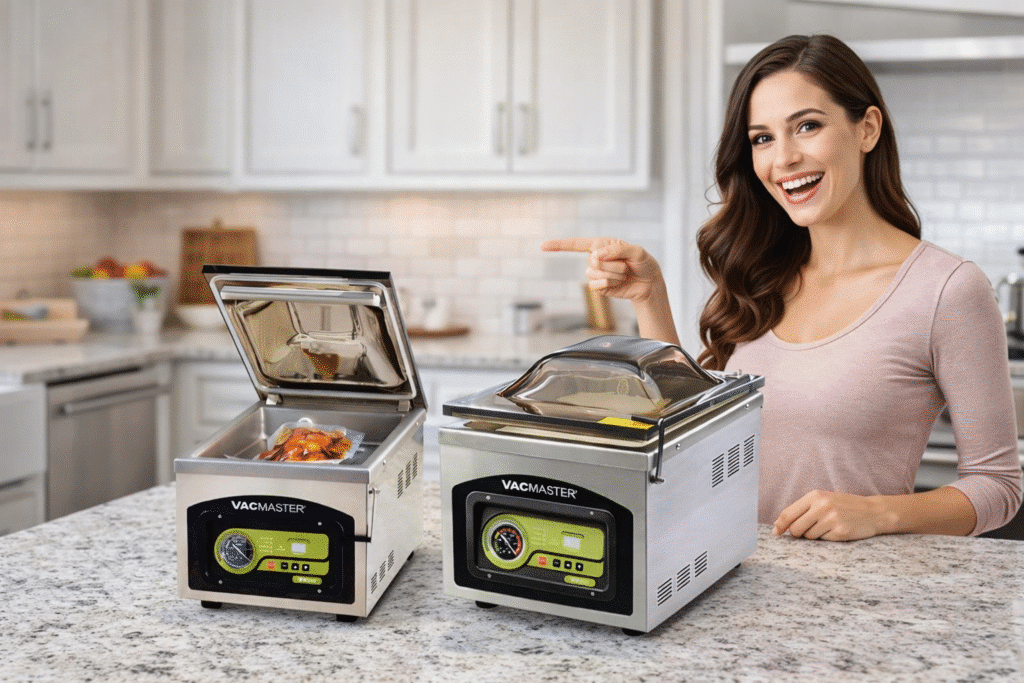
Lifting a 72-pound stainless steel machine onto a kitchen counter is a workout that reminds you exactly how serious chamber vacuum sealing is compared to those flimsy, vibrating suction sealers sold at big-box stores. For the past several months, I’ve transformed my garage and kitchen into a high-tech food preservation lab, alternating between the VacMaster VP210 and the VacMaster VP215.
If you are a serious sous vide enthusiast, a hunter processing large amounts of game, or a small business owner looking to portion out liquids like soups and marinades, you’ve likely encountered the VacMaster name. These machines are the “gold standard” for crossover appliances – tools that are compact enough for a dedicated home setup but rugged enough for a professional kitchen.
However, looking at the spec sheets for the VP210 and VP215 is a lesson in subtlety. They look identical. They share the same chamber dimensions. They even use the same 10.25-inch seal bar. But under the hood, these two machines couldn’t be more different. One is a maintenance-free sprinter designed for intermittent convenience, while the other is a heavy-duty marathon runner built on a foundation of oil and raw power.
The Key Difference: VacMaster VP210 vs. VP215 Chamber Vacuum Sealer
The fundamental divide between the VacMaster VP210 and the VP215 is entirely internal: The Air Pump vs. The Oil Pump.
- The VacMaster VP210 (The Maintenance-Free Sprinter) utilizes a dry, maintenance-free piston pump. Because it doesn’t use oil, you never have to worry about oil changes or the machine being tilted during transport. It’s lighter (72 lbs) and geared toward the home user who wants the benefits of a chamber sealer without the “mechanical” chores of owning a commercial machine.
- The VacMaster VP215 (The Heavy-Duty Workhorse) is built around a 1/5 HP Rotary Oil Pump. This is a true commercial-grade engine. The oil pump allows for a deeper vacuum, faster cycle times, and—crucially – the ability to run continuous cycles all day long without overheating. It is heavier (84 lbs) and requires periodic oil changes to stay in peak condition.
In short, the VP210 is for the user who values simplicity and “grab-and-go” convenience, while the VP215 is for the power user who needs maximum vacuum pressure and absolute reliability under heavy workloads.
Comparison Table: VacMaster VP210 vs. VP215 Chamber Vacuum Sealer
| Feature | VacMaster VP210 | VacMaster VP215 |
| Pump Type | Dry (Maintenance-Free) | 1/5 HP Oil-Rotary Pump |
| Weight | 72 Pounds | 84 Pounds |
| Seal Bar Size | 10.25″ (Double Seal) | 10.25″ (Double Seal) |
| Chamber Size | 11.25” x 15.25” x 5” | 11.25” x 15.25” x 5” |
| Cycle Speed | Standard | High (Faster Recovery) |
| Max Bag Size | 10” x 13” | 10” x 13” |
| Maintenance | None (Zero Oil) | Periodic Oil Changes Required |
| Best For | Intermittent home use/Liquid prep | Hunters, Fishermen, Small Business |
| View Current Price on Amazon | View on Amazon | View on Amazon |
Detailed Comparative Review: Living with the Vacuum
-
Design: Industrial Stainless Steel Stalwarts
Both machines share a nearly identical exterior. They are built like tanks with heavy-gauge stainless steel and a thick, transparent acrylic lid that allows you to watch the vacuum process in real-time.
- VP210 Experience: At 72 pounds, it’s still a beast, but it’s noticeably easier to move from a storage shelf to the counter than the VP215. The “dry” pump means I can store it on its side (if I really had to) or transport it in the trunk of a car to a neighbor’s house without worrying about oil leaking into the sensitive internals.
- VP215 Experience: This machine feels anchored to the earth. The extra 12 pounds of the oil pump make it a “set it and leave it” appliance. The finish is professional, and the lid has a heavy-duty gasket that creates an airtight seal with a satisfying thud.

- Easy To Use Control Panel and Pressure Indicator - Perfect vacuum and seal with minimal effort with one-touch controls....

- Easy To Use Control Panel and Pressure Indicator - Perfect vacuum and seal with minimal effort with one-touch controls....
-
Ease of Use: One-Touch Control Panels
The control panels are mirrored on both units. You have a digital display where you can adjust the vacuum time (usually 20-30 seconds) and the seal time (usually 1.5-2 seconds).
- The Process: I tested both by sealing a liter of tomato soup. Because these are chamber sealers, the pressure is equalized both inside and outside the bag. Unlike a suction sealer, the soup doesn’t get sucked into the motor. It just sits there while the air is removed from the entire chamber.
- The “Stop” Feature: Both have a manual “Stop” button. If I noticed my marinade was starting to boil (a common occurrence under high vacuum), I could hit “Stop” to trigger the seal immediately and prevent a mess.
-
Functions: The Vacuum Depth Test
This is where I started to notice the performance gap. While both are lightyears ahead of a standard “FoodSaver,” the VP215 is the superior “remover of air.”
- Vacuum Power: The oil pump in the VP215 pulls a slightly deeper vacuum. When sealing delicate items like berries, the VP215 consistently pulled more air out of the crevices.
- Cycle Consistency: During a Saturday afternoon where I was portioning out 40 pounds of ground beef, the VP210 started to feel a bit warm, and I felt like I needed to give it a minute between seals. The VP215 didn’t care. It churned through bag after bag without a single second of lag. This is the difference between a “home” pump and a “commercial” pump.
-
Maintenance: No-Work vs. Some-Work
The “M” word – Maintenance – is the deciding factor for many.
- VP210 Maintenance: There is none. You wipe it down, and you’re done. This is its greatest selling point. If you only vacuum seal once a week or for big holidays, not having to deal with oil is a huge plus.
- VP215 Maintenance: Because it has an oil pump, you have to check the oil level through a small sight glass on the back. You also need to change the oil after the “break-in” period and then annually (or more often with heavy use). Changing the oil isn’t difficult – it’s like a very small car oil change – but it is a chore that requires you to keep oil on hand and dispose of the old stuff.
VacMaster VP210 (The User-Friendly Choice) Vacuum Sealer
- Easy To Use Control Panel and Pressure Indicator - Perfect vacuum and seal with minimal effort with one-touch controls....
Pros:
- Zero Maintenance: No oil changes, ever.
- Liquid Friendly: Handles soups, sauces, and marinades with ease.
- Transportable: No oil means no risk of leaks during moving.
- Double Seal: Provides an extra-thick redundant seal for safety.
Cons:
- Duty Cycle: Not designed for 24/7 non-stop industrial use.
- Lower Pumping Speed: Takes a few seconds longer to reach full vacuum than the oil model.
VacMaster VP215 (The Industrial Powerhouse) Vacuum Sealer
- Easy To Use Control Panel and Pressure Indicator - Perfect vacuum and seal with minimal effort with one-touch controls....
Pros:
- Deeper Vacuum: Rotary oil pump pulls the most air possible.
- Faster Recovery: Built for continuous, back-to-back sealing.
- Durability: The oil pump is designed to last a lifetime with proper care.
- Quieter: In many cases, the oil pump has a smoother, less “clattery” sound than the dry pump.
Cons:
- Maintenance Required: You must change the oil to keep the warranty valid.
- Weight: At 84 pounds, it is a permanent counter fixture.
The Verdict: Which VacMaster Wins?
After sealing hundreds of bags, the winner depends entirely on your Volume and Willingness to Tinker.
I recommend the VacMaster VP210 if: You are a home cook who wants the incredible benefits of chamber sealing (liquids, marinating, sous vide) but doesn’t want another “mechanical” obligation. If you seal in batches but don’t run the machine for eight hours straight, the VP210 is a perfect, fuss-free tool that will last you for years.
I recommend the VacMaster VP215 if: You are a high-volume user. If you are a hunter, a fisherman, or someone running a small catering business, the oil pump is non-negotiable. The VP215 is a true commercial-grade machine that will never overheat on you, and it provides the absolute best vacuum seal available in a unit of this size.
My Personal Choice: I am keeping the VP215. While the oil changes are a slight annoyance, the speed and the “industrial” feel of the oil pump give me the confidence that I can process an entire deer or a bulk-buy from a warehouse club in one sitting without the machine breaking a sweat.
Frequently Asked Questions
-
Why is a chamber sealer better than a suction sealer?
A suction sealer (like a FoodSaver) sucks air out of the bag, which often pulls liquids out too. A chamber sealer removes the air from the entire chamber, keeping the pressure inside and outside the bag the same. This allows you to seal a bag of pure water if you wanted to. It’s the only way to effectively seal soups and marinades.
-
Can I use Mylar bags in these?
Yes! Both the VP210 and VP215 are capable of sealing 3 MIL to 7 MIL Mylar bags. This makes them excellent for long-term survival storage or coffee bean preservation.
-
Do I have to buy special bags?
The best part about chamber sealers is that they use flat bags, which are significantly cheaper than the textured bags required for suction sealers. Over a year of high-volume use, the machine practically pays for itself in bag savings.
-
How often do I change the oil in the VP215?
For a typical home user, once a year is plenty. If you are using it in a commercial setting, you should check the oil color every month. If it looks cloudy or dark, it’s time for a change.
-
Can I marinate food faster in these?
Yes. Because the vacuum pulls the air out of the fibers of the meat, it allows the marinade to penetrate deep into the food in minutes rather than hours. Both the VP210 and VP215 are elite tools for rapid marinating and cocktail infusing.