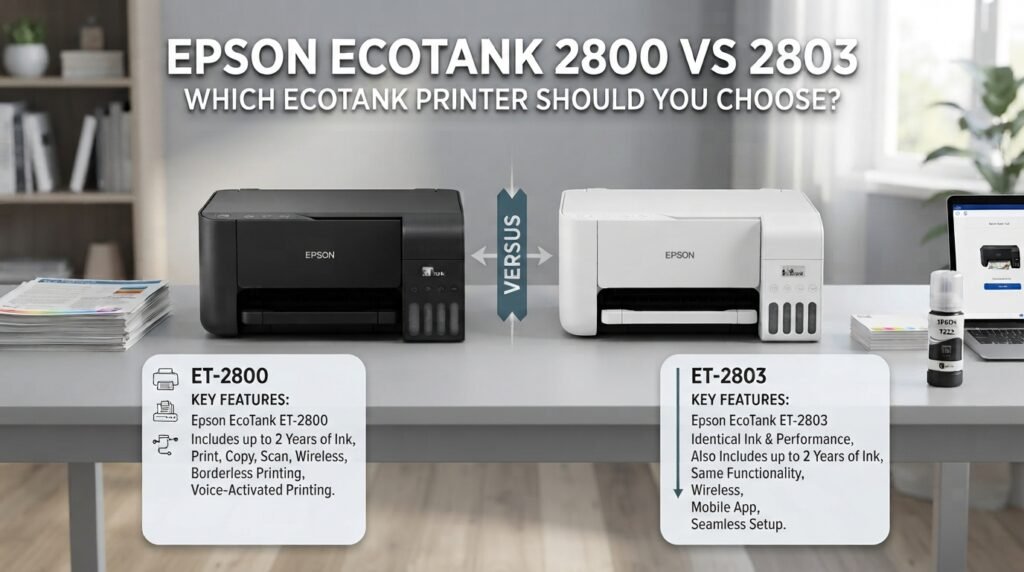
At first glance, the Epson EcoTank ET-2800 and ET-2803 look like almost the same printer. Both are wireless color all-in-one supertank printers built around Epson’s cartridge-free EcoTank system, and both are designed to handle printing, scanning, and copying at home. Their listed print speeds are also identical, making this comparison less about raw performance and more about the details that affect everyday convenience.
After comparing both models closely, I found that the differences are surprisingly practical. The ET-2800 weighs 11.56 pounds, while the ET-2803 is considerably lighter at 8.8 pounds. The 2803 also specifically lists USB and Wi-Fi connectivity, along with voice-activated printing, AirPrint, and the Epson Smart Panel app. The 2800, meanwhile, offers wired and wireless connectivity and emphasizes its EcoFit refill system, high page yields, and mobile printing capability. So while their core printing hardware looks very similar, the ownership experience can be slightly different.
Key Difference Between Epson EcoTank 2800 vs 2803
The biggest differences are weight and connectivity features. Both printers offer the same listed 5 ppm color and 10 ppm monochrome speeds, up to 4,500 black/7,500 color pages, and up to two years of ink. The ET-2803 is lighter at 8.8 pounds and specifically adds voice-activated printing, AirPrint, and Epson Smart Panel support in the supplied information.
Epson EcoTank 2800 vs 2803 Comparison Table
| Feature | Epson EcoTank ET-2800 | Epson EcoTank ET-2803 |
| Printer Type | Wireless Color All-in-One Supertank | Wireless Color All-in-One Supertank |
| Functions | Print, Scan, Copy | Print, Scan, Copy |
| Printing Technology | Inkjet / Micro Piezo Heat-Free | Inkjet / Micro Piezo Heat-Free |
| Color Printing | Yes | Yes |
| Max Color Speed | 5 ppm | 5 ppm |
| Max Monochrome Speed | 10 ppm | 10 ppm |
| Connectivity | Wired, Wireless | USB, Wi-Fi |
| Ink System | Refillable EcoTank | Refillable EcoTank |
| Included Ink | Up to 2 years | Up to 2 years |
| Black Yield | Up to 4,500 pages | Up to 4,500 pages |
| Color Yield | Up to 7,500 pages | Up to 7,500 pages |
| Scanner | High-resolution flatbed | High-resolution flatbed |
| Copier | Yes | Yes |
| Mobile Printing | Yes | Yes |
| Voice-Activated Printing | Not listed | Yes |
| AirPrint | Not specifically listed | Yes |
| Epson Smart Panel | Not specifically listed | Yes |
| Weight | 11.56 lbs | 8.8 lbs |
| Color | White | White |
| Refill System | Epson EcoFit bottles | Epson EcoFit bottles |
| Cartridge Waste Reduction | Yes | Yes |
| Check Latest Prices on Amazon | Check on Amazon | Check on Amazon |
Detailed Comparative Review
Design
The first difference I notice between these two EcoTank printers is their weight.
The Epson EcoTank ET-2800 weighs 11.56 pounds, while the ET-2803 weighs just 8.8 pounds. That’s a difference of 2.76 pounds, which is significant enough that I would notice it when moving the printer around.
For a permanent desk setup, weight may not matter much. Once I put the printer in its place, I don’t expect to move it every day. But if I’m setting up a home office, changing workspaces, or simply want a printer that’s easier to handle, the lighter ET-2803 has a clear practical advantage based on the supplied specifications.
Both models have a white finish and follow the same all-in-one EcoTank concept. I get a printer, scanner, and copier without needing separate devices.
Both also use high-capacity refillable ink tanks rather than conventional cartridges. That’s central to the EcoTank design and is one of the biggest reasons I’d consider either model for long-term home printing.
The physical difference therefore isn’t about one printer being fundamentally different in design. Instead, the ET-2803’s lower weight makes it easier for me to handle.
My take: I prefer the ET-2803 if portability and easier handling matter. If the printer is going to remain on one desk, the weight difference becomes much less important.

Epson EcoTank ET-2800 Wireless Color All-in-One Supertank Printer - White
- INNOVATIVE CARTRIDGE-FREE PRINTING — High-capacity ink tanks mean no more dealing with lots of tiny ink cartridges; Epson’s exclusive EcoFit ink bottles make filling easy
- LESS FREQUENT INK REPLACEMENT — Replacement ink bottles don't have to be changed nearly as often as ink cartridges¹; Printer, scanner and copier lets you print up to 4,500 pages black/7,500 color², equivalent to about 90 individual cartridges³
Ease of Use
Both printers are built to make ink refilling less frustrating than traditional cartridge replacement.
The ET-2800 uses Epson’s EcoFit ink bottles and high-capacity tanks. Epson specifically promotes the bottles as an easy way to fill the printer, while the cartridge-free system means I don’t have to repeatedly deal with small ink cartridges.
The ET-2803 uses the same general EcoTank approach and also features Epson EcoFit bottles. So I wouldn’t expect a major difference in the basic ink-refilling experience.
Where I see the ET-2803 pulling ahead is in its listed connectivity features. Epson specifically mentions wireless connectivity, hands-free voice-activated printing, AirPrint, and the Epson Smart Panel app.
That gives me several ways to send a print job from a compatible device. Instead of relying only on a conventional computer connection, I can use supported mobile and voice-based options.
The ET-2800 also supports mobile printing according to the supplied information, along with wired and wireless connectivity. So it isn’t lacking modern connectivity. The difference is that the ET-2803’s supplied description gives more specific details about the available mobile ecosystem.
My take: Both are relatively straightforward printers, but I’d find the ET-2803 more convenient if I frequently print from smartphones or want voice-activated printing.
View on AmazonFunctions
Functionally, these two printers are extremely close.
Both are all-in-one color printers with scanning and copying, and both use Epson’s Micro Piezo Heat-Free technology. Both are also rated at exactly the same maximum print speeds: 5 pages per minute for color and 10 pages per minute for monochrome.
That means I wouldn’t choose one over the other because of printing speed. There is no listed speed advantage here.
Their ink yields are also identical in the supplied specifications. Both can print up to 4,500 black pages and 7,500 color pages, and both are advertised with up to two years of ink in the box.
That’s an important point because the two models can look different on paper simply because their product descriptions use slightly different wording. Once I compare the actual listed yields, they are essentially matched.
The ET-2800’s description highlights its ability to produce sharp text and impressive color photos and graphics using Micro Piezo Heat-Free technology. The ET-2803 provides the same basic print-quality technology.
Both also include a scanner and copier. Epson describes the scanner as a high-resolution flatbed unit and includes a color display for document copying and navigation.
The ET-2803’s advantage is again in connectivity. Voice-activated printing and explicit AirPrint and Epson Smart Panel support give it a little more emphasis on modern device integration.
My take: The core functions are almost identical. I would look at connectivity and physical weight rather than expecting a meaningful difference in printing performance.
Maintenance
Maintenance is one area where the two printers are nearly impossible to separate based on the supplied specifications.
Both use high-capacity refillable ink tanks, and both rely on Epson EcoFit bottles. Instead of repeatedly throwing away empty cartridges, I can refill the tanks when needed.
Both also advertise up to two years of ink in the box, which reduces the frequency with which I’d need to purchase replacement ink during normal use.
Epson also emphasizes the environmental advantage of eliminating traditional cartridge waste. Both models are designed around this cartridge-free philosophy.
The supplied information for both models also emphasizes using genuine Epson ink for optimal print quality and performance. That’s worth keeping in mind when planning long-term ownership.
Because their ink system, page yield, and basic printing technology are so similar, I don’t see a major maintenance advantage for either printer.
The difference I’d pay attention to is not maintenance itself but convenience. The ET-2803’s lighter body and broader explicitly listed mobile-printing options could make everyday interaction with the printer a little easier.
My take: Maintenance is effectively a tie. Both use the same EcoTank concept and the same listed page yields, so I’d base the buying decision on connectivity and design instead.
Which One Fits My Printing Needs?
If I’m setting up a basic home office, either model gives me the essential functions I need: printing, scanning, copying, refillable ink, wireless connectivity, and color output.
The ET-2800 is a good fit if I want the standard EcoTank experience and appreciate having both wired and wireless connectivity listed. Its 11.56-pound weight isn’t particularly important if the printer will stay in one location.
The ET-2803 makes more sense to me if I want something lighter and expect to print frequently from mobile devices. Its explicit support for voice-activated printing, AirPrint, and Epson Smart Panel gives it a more modern connectivity profile in the supplied information.
Neither model has a print-speed advantage. Neither has a page-yield advantage. Neither has a clear ink-capacity advantage based on the specifications provided.
That makes the decision much simpler: choose based on how you plan to interact with the printer rather than expecting one to dramatically outperform the other.
Epson EcoTank ET-2800 Pros and Cons
Epson EcoTank ET-2800 Wireless Color All-in-One Supertank Printer - White
- INNOVATIVE CARTRIDGE-FREE PRINTING — High-capacity ink tanks mean no more dealing with lots of tiny ink cartridges; Epson’s exclusive EcoFit ink bottles make filling easy
- LESS FREQUENT INK REPLACEMENT — Replacement ink bottles don't have to be changed nearly as often as ink cartridges¹; Printer, scanner and copier lets you print up to 4,500 pages black/7,500 color², equivalent to about 90 individual cartridges³
Pros:
- Cartridge-free EcoTank design
- Refillable Epson EcoFit ink bottles
- Up to two years of ink included
- Up to 4,500 black pages
- Up to 7,500 color pages
- 5 ppm color printing
- 10 ppm monochrome printing
- Built-in scanner and copier
- High-resolution flatbed scanner
- Mobile printing capability
- Wired and wireless connectivity
- Micro Piezo Heat-Free technology
- Reduces traditional cartridge waste
Cons:
- Heavier than the ET-2803
- Voice-activated printing isn’t specifically listed
- AirPrint isn’t specifically listed in the supplied information
- Epson Smart Panel isn’t specifically listed in the supplied information
Epson EcoTank ET-2803 Pros and Cons
View on AmazonPros:
- Much lighter 8.8-pound design
- Cartridge-free EcoTank system
- EcoFit refillable ink bottles
- Up to two years of ink included
- Up to 4,500 black pages
- Up to 7,500 color pages
- Built-in scanner and copier
- Micro Piezo Heat-Free technology
- Wireless connectivity
- USB connectivity
- Voice-activated printing
- AirPrint support
- Epson Smart Panel app support
- Mobile printing
- Reduced cartridge waste
Cons:
- Same maximum print speeds as the ET-2800
- Same listed black and color page yields as the ET-2800
- No major performance advantage over the ET-2800 based on the supplied specifications
Epson EcoTank 2800 vs 2803: My Final Take
After comparing the two specifications closely, I wouldn’t describe the Epson EcoTank ET-2800 and ET-2803 as radically different printers. They share the same basic EcoTank philosophy, the same listed print speeds, the same page yields, the same Micro Piezo Heat-Free technology, and the same print/scan/copy concept.
The differences are mainly about handling and connectivity.
The ET-2800 weighs 11.56 pounds and lists wired and wireless connectivity. It gives me everything I would expect from a basic EcoTank all-in-one and is particularly suitable if I’m going to place it on a desk and leave it there.
The ET-2803 catches my attention because it weighs only 8.8 pounds. That’s considerably easier to move around. More importantly, Epson specifically lists Wi-Fi, USB, voice-activated printing, AirPrint, and the Epson Smart Panel app, giving it a more detailed mobile and smart-device connectivity package.
If I were choosing between the two for my own home setup, I’d lean toward the ET-2803 when I wanted the lighter body and more explicitly documented mobile/voice features. If those features weren’t important to me and I simply wanted a dependable EcoTank printer with wired and wireless connectivity, the ET-2800 would still cover the essential requirements.
The biggest thing I’d keep in mind is that print performance is essentially matched. Both are rated at 5 ppm color and 10 ppm black, and both offer up to 4,500 black and 7,500 color pages. So I wouldn’t pay extra for the expectation of faster printing based on these specifications.
For me, that makes the ET-2803 the more connectivity-focused option, while the ET-2800 remains a straightforward EcoTank choice. The right model ultimately depends on whether the lighter design and additional mobile/voice features are useful in my everyday workflow.
Frequently Asked Questions
-
What is the main difference between the Epson EcoTank 2800 and 2803?
The main differences in the supplied specifications are weight and connectivity features. The ET-2803 weighs 8.8 pounds versus 11.56 pounds for the ET-2800 and specifically lists voice-activated printing, AirPrint, and the Epson Smart Panel app.
-
Is the Epson ET-2803 faster than the ET-2800?
No. Both printers have the same listed maximum speeds: 5 pages per minute for color and 10 pages per minute for monochrome.
-
Do both Epson EcoTank printers have the same ink yield?
Yes. Both are listed for up to 4,500 black pages and 7,500 color pages. Both also come with up to two years of ink according to the supplied product information.
-
Is the Epson EcoTank ET-2803 lighter than the 2800?
Yes. The ET-2803 weighs 8.8 pounds, while the ET-2800 weighs 11.56 pounds, making the 2803 approximately 2.76 pounds lighter.
-
Which is better for mobile printing, the Epson 2800 or 2803?
Both support mobile printing based on the supplied information, but the ET-2803 provides more specific mobile and smart-device features, including AirPrint, the Epson Smart Panel app, and hands-free voice-activated printing. That makes it the model I’d consider if mobile printing is an important part of my workflow.